

SEO in 2026: how to stay visible when AI answers instead of Google

For twenty years, natural referencing has obeyed a simple rule: position yourself well in Google's blue links to recover traffic. This rule is being shattered. With the massive arrival of answers generated by artificial intelligence directly in search results, Internet users now often obtain their answer without ever clicking on a site. For a company, the issue is no longer just to be well ranked: it is to be cited.
Deciphering what will really change in 2026 — and what we need to put in place to avoid suffering.
What has changed: search becomes an answer engine
The upheaval has a name: AI Overviews (summaries generated by AI, formerly “Search Generative Experience”). Concretely, when an Internet user asks a question, Google now displays at the head of the page a synthetic answer written by its artificial intelligence, from the best referenced pages. The user reads the response, and in the majority of cases, does not click on any links.
The data speaks for itself. According to several industry analyses, a large proportion of Google searches are now concluded without any click to a third-party site, and this “zero-click” phenomenon intensifies on queries where an AI summary is displayed. The content most affected is purely informative content — definitions, quick comparisons, lists of best practices — precisely those that AI summarizes most easily.
The consequence is strategic: organic traffic remains a major acquisition channel, but SEO is no longer measured solely in clicks. It is also measured in citations, brand mentions and assisted conversions. Being the source that the AI picks up becomes as valuable as being in first place.
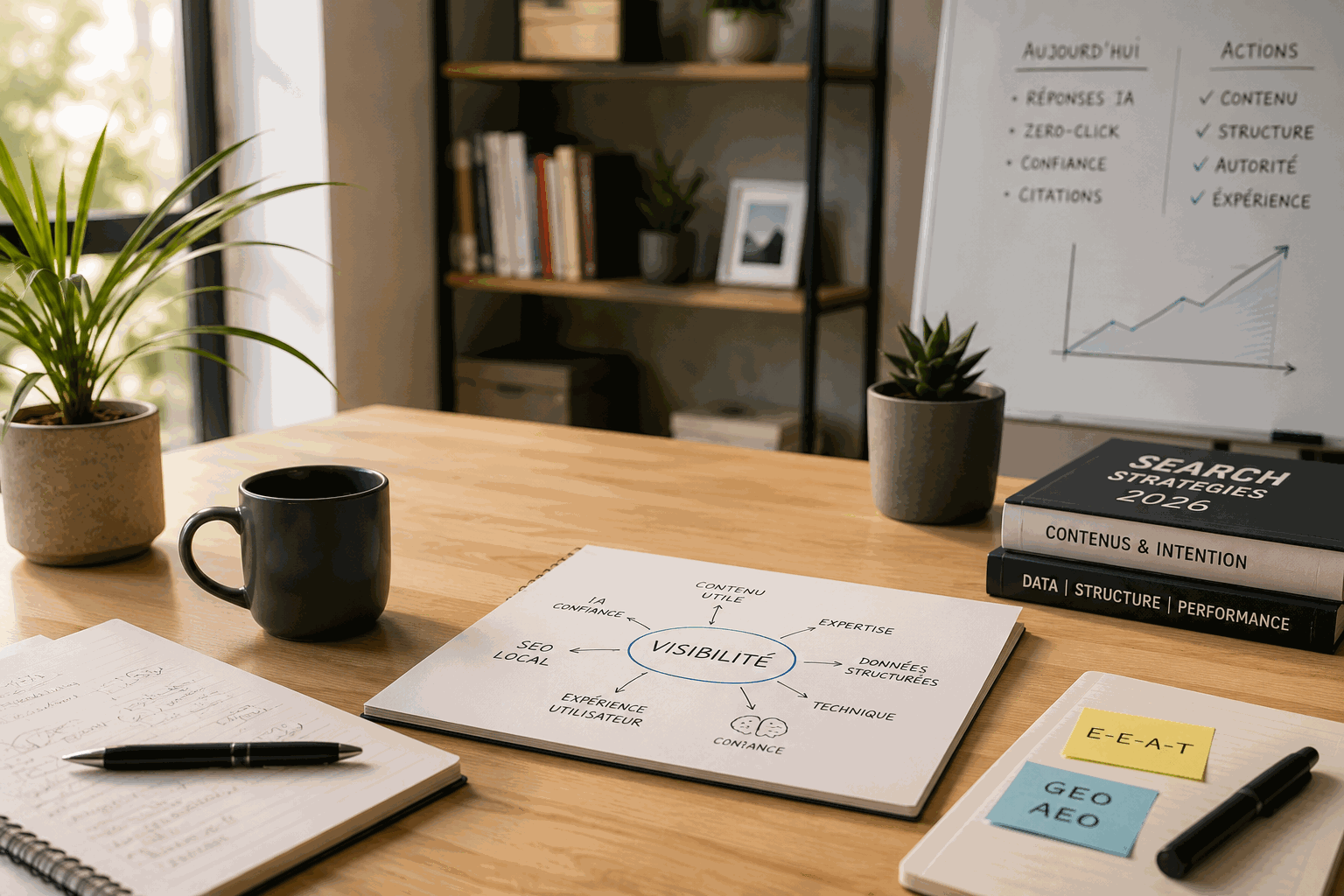
GEO and AEO: the new acronyms to know
Faced with this change, two disciplines are emerging alongside traditional SEO.
The GEO (Generative Engine Optimization) consists of optimizing your content to be taken up and cited by generative engines - not only Google, but also assistants like ChatGPT, Gemini or Claude, to which some of the searches migrate. AEO (Answer Engine Optimization) refers more specifically to the art of structuring content so that it directly answers users' questions, in a format that machines understand and use.
The good news: these approaches do not replace SEO, they extend it. A site that is already technically rigorous and recognized for the quality of its content leaves a head start to appear in the AI responses.
Concrete levers to stay visible in 2026
Here's what we really need to work on, in order of priority.
1. Strengthen your authority and credibility (E-E-A-T)
Google values experience, expertise, authority and trustworthiness more than ever — what SEOs call E-E-A-T. Concretely: content signed by real experts, verifiable information, cited sources, a brand that exists beyond its site (mentions in the press, customer reviews, networks). The AI draws priority from sources it deems reliable; becoming one of them is the central objective.
2. Produce content that AI wants to cite
The days of publishing a lot of generic content to “cast a wide net” are over. In 2026, in-depth, original and genuinely useful content is better than ten superficial articles. Content that provides proprietary data, an expert point of view, a study or concrete feedback is what the engines use — because they cannot be invented by AI alone.
3. Technically structure your pages
This is the most underestimated project. Structured data markup (JSON-LD), FAQ pages, clear answers at the start of sections, logical information architecture: all this helps generative engines understand and extract your content. A fast page, perfectly adapted to mobile and technically sound remains a non-negotiable prerequisite.
4. Working on the long tail and intention
Short and generic queries are the most “cannibalized” by AI summaries. Long, precise and high-intent queries (often commercial or local) continue to generate clicks and conversions. Targeting these precise intentions is one of the most effective countermeasures.
5. Capitalize on local SEO and branding
For an SME, local SEO remains an area where clicks survive: careful Google business profile, customer reviews, geolocated pages. At the same time, building brand awareness — so that people search for you by name — becomes an asset that neither AI nor your competitors can take from you.
SEO or SEA: should we arbitrate?
With the pressure on organic traffic, some companies are tempted to bet everything on advertising (SEA, Google Ads). This is an error in reasoning. SEA buys immediate visibility but that stops short as soon as the budget is finalized; SEO builds a lasting asset. The two are complementary: the paid one captures hot demand while the organic establishes your authority in the long term. The real question is not “SEO or SEA”, but “what balance according to your objectives and your maturity”.
What to remember
SEO is not dead in 2026 — it is transforming. Google and AI assistants become answer engines, and the goal shifts from “generate a click” to “be the cited source”. The fundamentals remain valid (quality, technique, authority), but they are enriched with a new requirement: making your content readable, reliable and structured for artificial intelligence. Businesses that adapt now will gain a lasting lead; those who wait will see their visibility erode without always understanding why.
This is exactly the work we do at Reqst: auditing, structuring and developing the visibility of our clients so that they remain found — by Internet users and by AI.
Want to know where you really stand? Request an audit of your visibility or book a call. Together we establish a clear diagnosis and actionable priorities.
Frequently
Asked
Questions
No. Natural referencing remains one of the most profitable acquisition channels in the long term. It is evolving: the objective is no longer just to be well ranked, but to be cited by the responses generated by AI (AI Overviews, conversational assistants). The fundamentals – quality, technique, authority – remain decisive.
GEO refers to the optimization of content to be taken up and cited by generative engines such as Google's AI Overviews or assistants such as ChatGPT, Gemini and Claude. It extends SEO by adapting the structure and format of content to AI logic.
This is the “zero-click” effect: when an AI summary directly answers the question in the results page, the Internet user no longer clicks, even if your site is well positioned. Informational content is the most affected. The solution is to target high-intent queries and become a cited source.
No, the two are complementary. The SEA provides immediate visibility as long as the budget is running; SEO builds a lasting asset. The balance depends on your goals, your industry and your digital maturity.
By strengthening the authority of your site (expert content, reliable sources, brand awareness), producing original and in-depth content, and technically structuring your pages (structured data, FAQs, clear answers) so that engines can understand and cite them.